
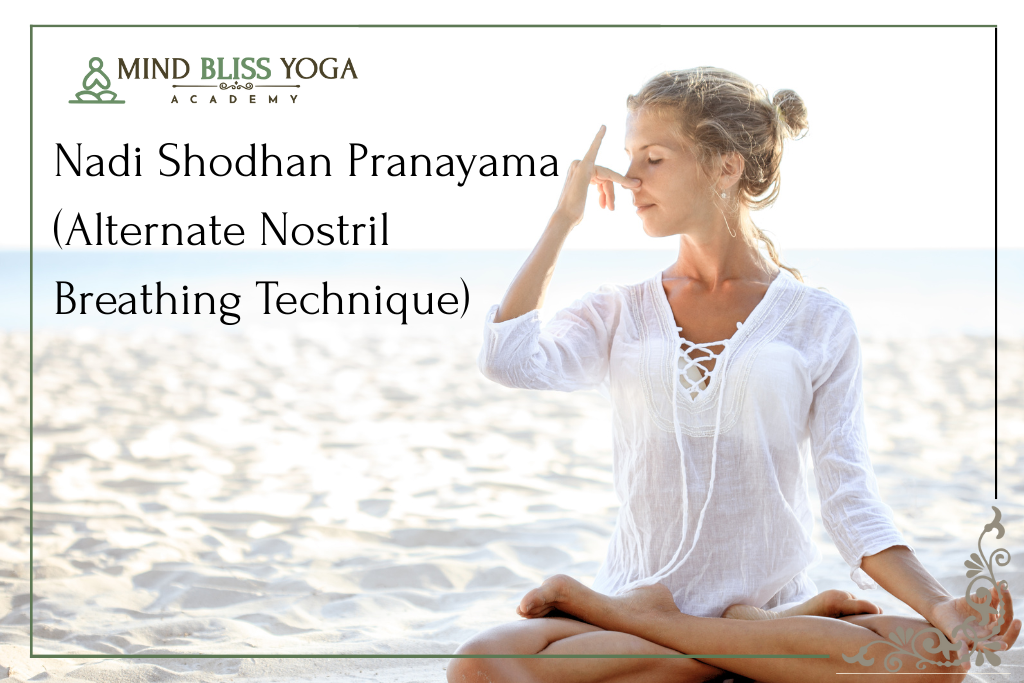
Among the top and most important pranayamas to include in your routine is that of Nadi Shodhan Pranayama or Anulom Vilom in common practice, or Alternate Nostril Breathing. As Old Hatha Yoga purports, immense health benefits attach to this pranayama which can be perceived almost very soon after practising. Very aptly termed “easy-practice,” anyone with lifestyle or any health condition can resort to this.
Mudra
Either Vishnu or Nasikagra Mudra would be the hand gesture used for this.
Vishnu Mudra: Keep the right hand for this gesture. Place the thumb on the right nostril and the ring finger on the left nostril. Fold the index and middle finger inwards towards the palm.
Nasikagra Mudra: Again, place the thumb on the right nostril and the ring finger on the left nostril. The first two fingers are gently rested on the eyebrow centre.
The choice of a mudra would depend on the structure and comfort of an individual’s hand.

How to Do
This pranayama always commences with an inhalation through the left nostril.
Close the right nostril using the thumb. Now inhale deeply through the left nostril. Close the left nostril using the ring finger, and at the same time open the right nostril and exhale through it. Immediately inhale through the right nostril, then close the right nostril and open the left nostril to exhale fully. This completes one round of Anulom Vilom.

I E I E – L R R L
For an advanced practitioner, breath retention is set into the alternate nostril breathing, creating Nadi Shodhan as a technique of breathwork.
Breath Retention Types
There are two types of breath retention:
Internal Breath Retention or Antar Kumbhak:
Beginning is a very important step: first, begin inhaling from the left nostril, then close both nostrils and hold the breath inside for a comfortable length. Open the right nostril and exhale. Now inhale through the right nostril only, close the nostrils again and hold the breath inside. Then exhale from the left nostril.
I (hold) E I (hold) E – L (hold) R R (hold) L
Check Out Sound Healing Course in India
External Breath Retention:
Another option is external retention. However, this is strictly to be used by seasoned practitioners only.
Inhale from left and hold breath inside. Exhale from right, block both nostrils, and hold breath outside for a comfortable period of time. Inhale right nostril, hold breath inside; exhale left, hold outside.
I (hold) E (hold) I (hold) E (hold) – L (hold) R(hold) R (hold) L (hold)
Choose the option you find comfortable as far as safety and control overdo breathing are concerned. As an initial step, your inhales and exhales can be set to an equal ratio. After some time and with much practice, you can extend the exhalations or begin to practice retention for either double the length of your inhalations or exhalations.
When to Practise?
Alternate nostril breathing is best practised early in the morning on an empty stomach, after your asana practice. This helps channelise the energies created through the movements and vitalise pranic energy in the body. If early morning is not feasible, the practice can be done in the evening before sunset.
This pranayama must be done without fail every day for the greatest benefits.
The Benefits
- Purifies nadis: Nadis are channels for prana to flow through the body. Through alternate nostril breathing, particularly with retention, blockages can be removed, enabling smooth pranic circulation.
- Balances energies: The stimulation of both nostrils brings balance between left and right sides of the body—yin and yang, or feminine and masculine energies.
- Soothes nervous system: This pranayama regulates the nervous system and balances sympathetic and parasympathetic responses.
- Reduces mental health concerns: Effective for anxiety, anger, insomnia, brain fog, low motivation, and depression.
Contraindications
Alternate nostril breathing has almost no contraindications. However, caution must be exercised when practising with breath retention. Individuals with high blood pressure, heart conditions, vertigo, epilepsy, or eye issues should avoid retention. It is also not advised during menstruation and pregnancy.
Final Note
Make this breathwork a part of your routine, and you will begin to see an improvement in your physical health, improved mind faculties, emotional maturity, and spiritual advancement.
Learn to more about nadi shodhan pranayama you can visit best yoga school in rishikesh and join 200 hour yoga teacher training in rishikesh